Chapter
Eight – Fraser House Big Meeting
BIG GROUP - USING COLLECTIVE SOCIAL FORCES
This Chapter outlines Big Meeting processes and Neville’s
leader roles. A summary of Big Meeting process written by patients (Appendix 8)
may serve as introductory reading.
Fraser
House was a substantial endeavour. Once under way it was having around 13,000
outpatient visits a year. While other therapeutic communities in the
Each
of the following terms were used to refer to the whole community meeting – ‘Big
Group’, ‘Big Meeting’, ‘Community Meeting’, ‘Large Group Psychosocial Therapy’,
‘Collective Therapy’, and ‘Big Group Therapy’.
Morning Big Group was held from 9:30 AM to 10:30 AM. Evening Big Group was from 6:30 PM till 7:30
PM. Big Groups were followed by a 30-minute tea break; then everyone reconvened
and separated into small groups.
In Neville’s paper, ‘Collective Therapy – Audience and
Crowd’ (1966; Yeomans, N. 1971c), Neville wrote, ‘the skilled use of
collective forces is one of the paramount functions of the socio-therapist and
such skills are defined by the team as ‘Collective Therapy’. In his paper,
‘Sociotherapeutic Attitudes to Institutions’ Neville wrote, ‘Collective
therapy, both audience and crowd, utilizes social forces in the patients’
primary group (Yeomans, N. 1965a, Vol. 12, p. 46, 60-61).’ Neville engaged all involved in Fraser
House in recognizing, understanding and utilizing these social forces. The
Fraser House Handbook (excerpts in Appendices 7 and 8) also refers to audience
and crowd behaviour, especially contagion, being a central aspect of Big Group (Yeomans, N. 1965a, Vol. 4, p. 18-20, 50-54).
For a time, Big Group
involved around 100 people and then it grew to around 180 people. According to
Chilmaid (April 1999), it peaked at 300 on one occasion. All these people would
be crammed shoulder-to-shoulder into a rather small room – in Neville’s terms,
‘a mixture of the very mad and the very bad patients’, along with their
typically dysfunctional friends, workmates and relatives as outpatients. All
the staff on duty at the time would also attend. Often there were visitors and
invited guests also attending Big Group. People who attended the Fraser House
Psychiatric Research Study Group (discussed later) also attended Big Group,
along with people from religious, business and government organisations
interested in learning group skills. Fraser House became a major centre for
learning group skills, with people from many government, academic and
non-government organizations attending. Neville said that much of the training
was done by patients (August, 1998). Neville would also invite people from the
media, students, as well as people Neville connected with through his extensive
outreach talk schedule. Others who made requests to attend would also be
allowed in. Margaret Cockett (who became Neville’s personal assistant) was in
this category of visitor on her first visit. Members of Alfred Clark’s External
Study Team would also attend. On one occasion a TV crew from the ABC came and
filmed a section of Big Group. (I was not able to track down this film in the
ABC archives.)
Some patients had jobs that they would go to
during the day. They would attend evening Big Group. According to Chilmaid in
an email (Mar, 2003):
Evening Big Group was mandatory for all in-patients
unless excused by the Ward Committee (employed relatives living in, parental
duties, children, etc). Not all staff attended evening group.
In another email Phil Chilmaid (April, 2003) wrote,
Children did attend Big Groups, but this wasn't de
rigueur. High school children usually did attend when not at school. Primary
school children had separate play time during evening group with the
psychologist Porritt when he was there; a lot depended on the numbers and ages
of kids at any particular time.
Porritt and a senior nurse spent time in observation and
play therapy with the children at the same time as Evening Big Group. Also, a
couple of nurses remained on rounds (and made tea for the report session)
Chilmade 2003). Evening groups catered for friends and relatives who found it
difficult to come during the day, and for inpatients that worked during the
day. Very occasionally the evening Big Group became a Special Group and
mandatory for all. Mostly evening Big Groups were well attended, probably 80%
of morning Big Group. In an email Bruen (Mar, 2003) wrote:
As I recall, the evening groups were compulsory for
inpatients but not for outpatients. However, family members of inpatients
were strongly encouraged to come in the evening, and there was a strong
emphasis on family dynamics for attendance by those families whose relatives
could only come in the evening.
Once Big Group started, the
ground rule was that no one left before it was finished. A toilet was
available within the room behind a screen. Two staff were assigned to be
recorders, one for content, and one for process. Big Group process records were
kept in a very large hard covered red book. This assignment was rotated to
improve staff’s process observing and attending skills. This record was
referred to during staff discussion in the tea break following Big Group. I
have been unable to trace this red book. It seems that no records exist of any
aspect of Fraser House in Government records. Neville and Margaret Cockett both
confirmed (Oct 1999) that there were powerful forces very determined to see all
trace of Fraser House eliminated. I could find no health department
archives relating to Fraser House.
The Big Group meeting room
was the lower building behind the white car in the photo below.
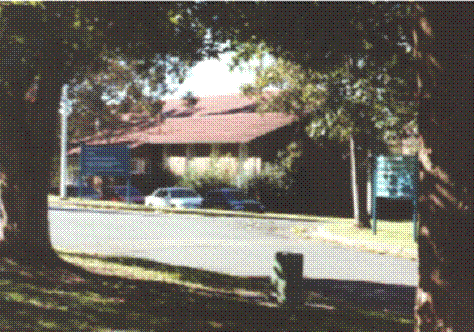
Photo
1 A photo I took in October 1998 of the room at Fraser House
where Big Group was held
One of the Fraser House
Handbooks (Yeomans, N. 1965a, Vol. 4, p. 1-54) confirms that during the staff discussion in
the tea break following Big Group, the two official observers for the meeting
used the Red Book to give their report to staff, followed by comments by all
staff members present, including the Group Leader/Therapist.
The points assessed were: mood,
theme, value and interaction, therapist’s role and techniques employed. From
these ‘post-mortems’ comes much of the knowledge needed.
These four aspects - mood,
theme, value and interaction were the essence of what Neville was personally
constantly scanning for. These guided his interacting with the group. In having
these as the ‘discussion framers’ along with Neville’s role and process,
Neville was fast-tracking all staff into his way. Note that while these review
session were very involving, they were condensed by being limited to 30
minutes. They happened twice a day so the ‘unfinished’ may be taken up later if
deemed a potent theme.
The aim must be always to
look at the community in the ‘BIG’ – as a whole and this certainly is no easy
matter (Yeomans, N. 1965a, Vol. 4, p. 51)
Neville also scanned the ‘BIG’ – the-whole-of-it - like
his family did on the farm. The handbook notes that this was ‘no easy matter’.
Simultaneously Neville was scanning for minute subtle nuances. Neville had
‘attending’ as a highly developed resource state.
Some of the ways in which an emergent theme may be linked
to sections of the total community are indicated in the following quote from
notes on how to run Big Group (Appendix 8):
Usually the therapist then allows the group
to enter into spontaneous ‘free floating’ discussion until a general
interconnecting theme is apparent. This may then be pursued with promptings
towards interaction between different generations or social classes or
psychiatric opposites – or perhaps to tie in together for mutual support those
with similar difficulties, personally or because of family or life-crisis
situation (Yeomans, N. 1965a, Vol. 4, 50-54).
On staff review of groups, an email Bruen (Mar, 2003)
stated:
The staff meetings to discuss the group were for staff
only. The summary was recorded but not made available to patients or
families. These summaries were used mainly as a training exercise in what to
look for in a group and to update staff at change of shifts - dynamics often
changed very quickly at Fraser House and staff needed to be up with the latest.
Also in an email Chilmaid (Mar, 1999) wrote:
While the feedback/report by the observers was given at a
half hour staff meeting (with a cup of tea and sandwiches) it was not unknown
to query the observers about content earlier in the Big Group during the
meeting.
Neville always led Big Group
when Fraser House was first set up. He was both evolving processes and
modelling these for staff. After a time, others began to get a feel for how to
do it. Big Group was then also taken by medical staff. Later on, some nurse
leaders also lead Big Group. As mentioned, three of the people I interviewed
for this research, Cockett, Bruen, and Chilmaid all ran Big Group many times.
After Neville left Fraser House in 1968 some Big Groups were even run by
skilled patients. This was reported by Warwick Bruen (Interview April,
1999).
Thursday morning Big Group was ‘administrative
only’. Administrative matters were discussed and patient committee elections
were held under the auspices of the Parliamentary Committee. Reports were also
received from the other committees.
During an interview/conversation with Neville
(April, 1999) he stated that any attempt to bring up an administrative matter
in a therapy group was deemed to be ‘flight’ and was interrupted with
compassionate ruthlessness. Any attempt to bring up a therapy matter during an
administrative group was deemed to be ‘obstruction’ and deferred.
The distinction in function between the Administrative
Big Group and the other Big Groups is detailed in the following quote from the
Staff Handbook (Appendix 8):
Morning community groups have two main therapeutic functions;
personality change is the aim of four meetings, while social control is the
focus of the Thursday morning administrative group (Yeomans, N. 1965a, Vol. 4, 50-54).
It was not ‘administration’ to sort out staff
administration; rather, it was ‘administration’ for furthering the mutual-help
based social control of the total community by the total community.
During
Big Group everyone - including staff, outpatients and guests - were ‘in
therapy’. Visiting Family, workmates and friends would ‘sign on’ as
outpatients. In an April 1999 conversation with Warrick Bruen he said that
while it was not ‘spelt out’ to staff that they too were ‘in therapy’, a person
could not be in Big Group and not be ‘in therapy’; it was just so
‘dense’ that people had to have psychosocial and emotional shifts occurring.
This view was confirmed by Neville, Margaret Cockett and Phil Chilmaid (April,
1999). This is resonant with Maxwell Jones’ comment that anyone in Fraser House
had to change (Clark and Yeomans 1969, Preface).
Preventing Session
Creep
Neville told me (June, 1999)
that all therapy sessions at Fraser House were set strictly at a length of one hour.
Timing of the following tea break and the one-hour small group was also
strictly adhered to. When the Big and Small Group hour was up they stopped,
even if it was in mid sentence. Neville said (30 June 1999) this strict
adherence to time was specified by him after reading articles that therapy
sessions get progressively longer once over forty-five minutes. What tends to
happen is that people leave opening up and sharing to the last five minutes,
and when they do open up there is some pressure there to work through
something, and the session is extended. Next time nothing much happens till the
last five minutes of the longer period, and so the session extends even
further. To stop this ‘session creep’, Neville set sixty minutes as the
non-negotiable length.
Big Group Layout
So that everyone could see
everyone at Big Group, moveable wooden tiers were set up along each of the long
sides of the Big Group room. Staff, patients and outpatients were all mixed
together in a self-organising process. A raised podium was set up at the far
end for the two recorders who kept a transcript of the proceedings.
The Big Group room was
rather small for the numbers that crammed into it - around 8 metres by 16
metres. Neville, Bruen and Chilmaid (April 1999) confirmed that typically, the
attendees sat in two rows along both of the long sides. Attendees were all
jammed in shoulder to shoulder. When the numbers exceeded 180, there would be
three rows along one or both of these long sides.
The Sixties were a
time when women were generally quiet in men’s presence and would be quiet if
men were talking. In other hospital environments this reticence to talk in the
presence of men tended to apply to both female staff and female patients. An
observation made by Phil Chilmaid (August 1999) was that at Fraser House,
females were often passionate contributors in groups and would often catch the
group’s focus and hold the floor.
Outside of Big and Small
Groups, all involved in Fraser House were dispersed throughout the quarter of a
kilometre long complex. In squeezing the total community and visitors into Big
Group, Neville was creating concentrated cultural locality. Everyone was part
of the shoulder-to-shoulder crowd; everyone was audience and spectator. And
everyone knew they could become the centre of the crowd’s focus and that this
could happen at any time. Being the focus of Big Group was a very potent
extraordinary socio-emotional experience. Neville was very adept at creating
the unexpected sudden shift in group focus. That anyone could become the focus
of group attention at any moment served to create and maintain tension in the
group.
A Mood That
Attunes
Mood was one of the four
aspects of Big Group that was discussed at the following thirty minute staff review.
A key part of the Big Group reality was maintaining a ‘healing environment’
that was a ‘natural growth force’. The German word ‘stimmung’ is
apropos. ‘Stimmung’ has, as one of its meanings, ‘a mood that attunes people
together’ (Pelz 1974, p.89-90). Within Big Group, Neville set up processes
whereby the collective stimmung that was maintained for the time together was
tuned to healing (Pelz 1974, p. 89-90). However this did not necessarily mean
gentle caring and kindness. Healing often entailed what Neville called, ‘ruthless
compassion’. Healing was at times rugged and relentless. It was at times
exhilarating and at other times it was emotionally draining. In separate
discussions with Neville, Warwick Bruen and Phil Chilmaid (April 1999), they
all confirmed that Big Group was very tightly structured and that no one liked
it - staff and clients alike. At the same time it was widely acknowledged among
both patients and staff that Big Group was very important - a crucial aspect of
the Fraser House change-work.
Neville’s exploring of
stimmung was resonant with the following remarks (about a group of people
attuned to each other) by Jaworski’s (from his conversation with theoretical
physicist Dr. David Bohm mentioned in part in Chapter Four):
It’s activating a single intelligence
that works with people who are moving in relationship with each other. Cues
that pass from one to the other are soon picked up with the same awareness just
as we pick up cues in riding bicycles or skiing. Therefore these people are
really one. The separation between them is not blocking. They are all pulling
together. If you had a number of people who really pulled together and worked
together in his way it would be remarkable. They would stand out so much that
everyone would know they were different (1998).
People did recognise that
Big Group was very special. That’s why religious leaders, academics,
bureaucrats, businessmen, media people, people from all walks of life came to
experience it and co-learn.
Big Group was run
like a meeting (Yeomans, N. 1965a, Vol. 4, p. 18, 50-54). In writing about group process the handbook states (refer Appendix
8):
‘The first essential in taking a group is to
see it as a meeting and like all meetings, there is a need for a chairman to
conduct affairs and keep issues to the point. ‘The function of the therapist is
to see that the group functions as a group. Be directive. The group could
function well if the chairman adopts a completely passive and wordless role (Yeomans, N. 1965a, Vol. 4, p. 17-20, 50-54).
Bruen commented (interview
April, 1999) that Big Group was ‘exhausting for all present’ and that the
leader had to be ‘really on the ball’ and ‘aware of everything’. Within Fraser
House any destructive behaviour was interrupted, and dysfunctional
behaviour was regularly occurring because of the nature of the
patient/outpatient population. This dysfunctional behaviour was often
interrupted with what Neville described as ‘ruthless compassion’.
One of the Fraser House
Handbooks includes the following comment on Big Group process:
When both the staff and
patients are working well together in the Unit, a peak of enthusiasm is reached
at times when everyone sees almost any move at all as being gainful. New
enterprises are embarked upon with an eagerness that is almost inspired and
success is a certainty.
Again, when as a whole the
big group is swayed by frustration, contagious aggression and excitement result
- just as contagious as the feelings of fear and panic experienced due to
shared threat anywhere (Yeomans, N. 1965a, Vol. 4, p. 51).
The Handbook notes that
theories of behaviour of crowds and audiences apply to Big Group.
My interviewees all confirmed the following:
1.
Creating
a collective mood tuned to healing that colours the collective reality as
healing, is itself therapeutic.
2.
Within
Fraser House, the realized (in the two-fold sense of ‘made real’ and
‘understood’) reality/context, the shared meanings about ‘what we are here
for’, and the collective mood, were all healing.
3.
All
participants (apart from newcomers) shared memories of previous Big Groups
where healing had occurred in the shared cultural locality of the Unit’s Big
Group Room. The very space in the room had become healing space. Healing
memories were anchored (Hanlon 1987) to that space.
Given the prevalence
of pathology, Big Group as ‘healing stimmung’ was still riddled with people
doing their best with pathological repertoires, including dysfunctional beliefs
about the world and each other, as well as problematic values, attitudes and habits
and pervasive self-doubt. All of these were being constantly held up to
community scrutiny and challenged. Neville had highly refined competences to
ensure functional interaction in this dysfunctional seething.
A lot of Big Group
was like theatre with vocal people sometimes being rather passionate and rowdy.
This was attested to by Neville, Chilmaid and Bruen (interviews April, 99). Big
Group meetings were sometimes extremely frightening and challenging. Despite
this, the context was framed as healing and very tightly controlled. People were learning to be able to make value
and moral based discriminations in discoursing about everyday life issues
rather than just using utility as a criterion, or being unable to express
themselves at all.
ON NEVILLE’S ROLE AS
On the Side of Constructive Striving
Every person I interviewed
connected to Fraser House said that Neville’s group process skills were way
ahead of everybody. In the following section I endeavour to unpack some of his
processes.
To repeat, Neville was
continually scanning everyone (including various factions and isolates) to
sense mood, theme, value and interaction (Bruen in April 1999). Neville
discussed his own process in a monograph entitled, ‘The problem of Taking
Sides’ (Yeomans, N. 1965a, Vol. 5, p. 46-47). Neville’s process for working with
destructive non-ecological behaviour was as follows (Yeomans, N. 1965a, Vol. 5, p. 66). Whenever Neville was with more than one
person, he was always on what Neville called ‘the side of the constructive
striving’ of everyone present - their ecological bits (defined by Neville as
‘what was functional in the context’) – what Neville called, ‘the free energy’.
This is isomorphic with the Keyline principle, ‘make use of the free energy in
the system’ (Yeomans, N. 1965a, Vol. 5, p. 66). The essence of this process was that
Neville never took sides verbally or non-verbally. When carrying out therapy
with family and friends within Big Group, Neville did not take the side of any
one person. Rather, Neville took the side of, or supported what he called ‘the
healthy component of a role in the relationship between the individuals
concerned in that unfolding context’ (Yeomans, N. 1965a, Vol. 5, p. 66).
The following quotes are
taken from Neville’s ‘The problem of Taking Sides’ monograph (Yeomans, N. 1965a, Vol. 5, p. 46-47) . When working within the intra-psychic structure
of any one person in the family group, Neville wrote that he supported:
certain role behaviours of
the particular individual and not other role behaviours.
More specifically, he
supported:
the normal component of
certain roles undertaken by the person in the particular context.
Neville did not take sides
between the two or more individuals, even though typically they may be
attempting to make him do this. Neville was constantly supporting what he
termed:
the positive
component in role relationships, and in any one individual in the role
relationship - that person’s positive role behaviour component.
Using this process, it was
surprising easy for Neville to flow very comfortably through the most
potentially disturbing of family quarrels and conflicts. Within the unfolding
context, Neville was supporting what he termed:
the normal component of
their role relationships, and consequently the normal component of the
intra-psychic role structures
Neville was, intra-psychically speaking:
supporting the normal
sub-total of roles in the individual and the group
At the same time, Neville
was not supporting and condoning:
the abnormal role part
functions of any in the group
Looked at from the
perspective of a person’s total personality, Neville was:
personally supporting each
member of the group as a person, while fundamentally not supporting or
condoning anyone’s abnormal behaviour. Each member of the group was accepted.
Everyone’s abnormal behaviour was rejected. The tension in each individual within
the family/friendship sub-group was thus supported towards the normal.
What Neville was actually doing in the
unfolding context was continually changing his position as a function of the
particular roles that were being attempted by one or other of the partners in
the exchange. Neville was always supporting the context specific healthy role
functions. A colleague David Cruise
pointed out the resonance of the words of the Henry Mercer song (Mercer 2000):
Accentuate the positive
Eliminate the negative
Latch on to the affirmative
Don't mess with Mister
In-Between
In this context,
Neville was a ‘positive Mr. In-between’ and according to all of my interviewees,
he was so far ahead of everyone else in his strategic ruthless compassionate
caring, that it was best not to ‘mess’ with him.
The following outline of Neville’s behaviours
in Big Group was confirmed by interviewees and is consistent with Neville’s
paper, ‘The Problem of Taking Sides’ discussed above.
In Big Group, if anyone was destructively
attacking another person present, Neville said (June 1998) he engaged the
attacker and momentarily gave then his attention. He then immediately
interrupted the attacker, and suddenly withdrew attention. Neville would switch
his full attention to the person being attacked and ignored the attacker, and
possibly the ongoing attacking. This sudden withdrawal of attention from the
attacker was all the more potent because Neville’s prior engagement was so
strong. At the same time he would continue to monitor the attacker as part of
continual meta-scanning of the whole group and group process. He may provide
support and comfort, and respond to any constructive striving of the victim.
This behaviour ‘rewarded’ the victim and was ‘punishing’ the attacker.
Sometimes he may isolate out and focus on the constructive and functionally
appropriate-in-context aspects of the attacker’s behaviour and use this to
interrupt the destructive aspects. Neville was very adept at this rapid pattern
interrupt to non-functional-in-context behaviour. Neville said that aspects of
the interrupt process may include the sudden removal of gaze, the rapid turning
of eyes, head and body away from the attacker, the cessation of Neville’s
attention (as perceived by the attacker), perhaps the hand up, ‘stop now’ hand
gesture of the traffic policeman, the non-acknowledgment of the attacker’s
words and being-in-the-room, and the engagement of the ‘victim’ as Neville’s
(and the Groups) new centre of attention.
Typically, the victim became the new centre
of the group-as-audience’s attention and the attacker was for the time, ‘excluded’
by the Group process. This was an example of Neville’s use of social forces.
This sudden withdrawal of being the centre of the Group’s attention, the taking
away of the supports to the attacker’s ‘taken-for-granted what’s happening’-
this ‘denial of the attacker’s reality’ - typically creates an internal
‘interrupt’ to their state and functioning. Often they go into momentary
confusion (Hanlon 1987). Often the ‘state’ of the suddenly
interrupted person may collapse. For example, ‘anger’ may collapse through
‘confusion’ to ‘frustration’ to ‘brooding’ till the dramatic theatre unfolding
around them ‘captures’ their attention and they shift to being profoundly
engaged as part of the audience to other’s change-work. Bruen and Chilmaid
confirmed Neville’s use of the above behaviours (Oct 1998, April 1999). Neville
termed the functional behaviour in context ‘the ecological bits’. Neville
would, in his terms, ‘support the ecological bits of all concerned’. He would
support ‘the functional behaviour in context and ignore the dysfunctional
behaviour in context’. Neville (June, 1998) called this ‘ecology therapy’ (Yeomans, N. 1965a, Vol. 5, p. 46-47).
Neville was particularly interested in
processes for crowd synchrony and contagion and how to use this for enabling
caring and wellbeing. Neville’s models for his own Big Group leader behaviour
were Churchill, Hitler, Billy Graham and Jesus - that is, people who could
create crowd synchrony and contagion; people who could inspire, manipulate,
emotionally move and control a crowd. He did not use them as content models
(except Jesus’ love). Neville (July 1998) said that he often mentioned to staff
and clients that he used these charismatic people as process models.
Neville’s abiding
metaframe was love surrounded by humane caring, psychosocial ecology, and
safety. Aspects of this metaframe emerge through this research. In a 30 June
1999 telephone conversation Neville said that one appeal of charismatic leaders
is that:
….for many followers,
the paradox of existence requires the intervention of the miraculous. Many
believe that such leaders can deliver miracles.
When I asked ‘and
there were miracles at Fraser House?’ he said with flourish:
Of course it was
miraculous. We were the best in the planet, and we all believed this, so we
would acknowledge our failings, as we were streets ahead of everyone
else. I was accused of being an impossible optimist. I sense I was more of a
fatalistic optimist. I was context driven - if I go to ‘creative context’ then
‘everything is creative’ - it worked like that. As for the miraculous - well that
was a calm night.....peaceful.... remember we were filled with the very bad and
the very mad - the under controlled and the over controlled.
Neville’s Sensory
Functioning
According to Bruen
and Chilmaid (April, 1999), Neville had an amazing ability to perceive inside
and outside of the person(s) he was attending to, as well as every person in
the group (up to 300), and to do all this instantly, and be ten or more steps
ahead of everybody in a very strategic way. Neville had the
capacity to recall virtually verbatim everything everyone said and even the
subtlest non-verbals and actions over at least the whole of a one-hour Big
Group (around 180 people) or small therapy group at Fraser House. Often he
would refer a person back to what they had said 20 or 40 minutes ago and be
able to repeat verbatim what they said back to them.
It
seems that in sensory terms, when Neville was tuned into social interaction, he
typically stayed attending to external contexts as opposed to internal
recalling or imagining seeing and hearing things. Neville told me (June, 1992;
June, 1998) that he would receive thoughts as guides to action as ‘bolts out of
the blue’ – out of internal silence – with these, and their link to unfolding
action, linked to his immediate (fast) emotional and kinaesthetic responses as
a check on ecology and ‘fit’. He could attend to specifics and scan the context
concurrently, always looking for the free energy in the social milieu. For
Neville, ‘free energy’ was what he termed ‘the context specific and resonant
functional bits of behaviour’ and the ‘psychosocial resources’ in each person
present.
Place
was fundamental for Neville. Initially I had not realized that when he and I were
talking about another place (or events in another place) to the place we were
situated, Neville would mentally place himself in this other place as an aid to
discussion and functioning. Similarly, Neville always checked out his and
others’ context and meta-context (the context of the context) in social
exchange, so that he could get a feel for the interconnections in
everyone present (Goffman 1974). None of this detail
ever bogged him down or cluttered the conversation. Neville was a man of few
words – for him, the less said the better.
THE
FAR-FROM-EQUILIBRIUM LEARNING ORGANIZATION
The Fraser House
milieu was like the soil on the Yeomans’ farm. It was complex, interwoven and
maintained in a thriving state because of very strategic redesign features that
Neville set up and sustained - fully consistent with thrival aspects within
individuals as living system, and between individuals as the Fraser House
living system.
Fraser House was what
Senge called thirty three years later a ‘learning organization’ (1992). The Unit had a culture of continual review,
innovation and openness to try new ways, leading to sustained negentropy (the
opposite of entropy). Neville was implementing what Deming termed ‘a culture of
continual improvement’ (2005).
Living systems that
are adaptive and thriving well, while being provoked and challenged by the
surrounding ecosystem, are usually in far from equilibrium states (Capra 1997, p. 85-94, 102, 110, 175-178, 187). In complexity terms, every aspect of Fraser
House was structured by Neville and others to maintain the Unit in a far from
equilibrium state. When situations within Fraser House became stuck, Neville
would intentionally perturb it, and then use the evoked heightened emotional
contagion as emotional corrective experience.
Gain,
Loss, Threat and Frustration
Neville spoke (discussion
Dec, 1993 and July 1998) of four major themes stirring emotions being gain,
loss, threat and frustration. Neville would expressly make strategic use of
incidents with a high probability of heightening emotional arousal associated
with these four themes within Big Group.
Among the appendices are
three cases studies providing revealing glimpses of Neville’s processes and the
Fraser House community in action:
Appendix 14 is a Case Study
about how Neville intentionally heightened the group’s emotional arousal during
a Big Group meeting using the themes gain, loss, threat and frustration.
Appendix 15 contains two cases.
The first is about Neville mobilising the Fraser House community to be at its
very best in supporting a 12 year old girl and her foster parents in a Big
Group meeting expecting the arrival of girl’s mother who has just served twelve
years in prison for murdering her other children. The mother arrives obsessed
with killing the 12 year old.
The second case is Neville’s
strategic intervention where a patient in his upstairs dorm is threatening to
stab his wife.
SUMMARY
This chapter has outlined the use of collective social forces in Big Group meetings, and the collective therapy processes evolved at Fraser House for working with attendees as both audience and crowd. The difference between Therapy Big Group and Administrative Big Group was described. Post Big Group staff reviews of mood, theme, value and interaction along with discussion on the therapist’s role and techniques were outlined along with Neville’s leader roles and group process. The next chapter looks at change processes evolved at Fraser House. Neville’s evolving of Cultural Keyline from Keyline is analysed.